
Between the age of 50 and retirement at 62, disabled workers have little professional activity. Less than four years on average. They therefore have to spend eight years without pay or pension.
Disabled individuals stop working earlier… but retire later. This is a paradoxical situation highlighted by the latest study from Drees. Paradoxical but logical given the regulations and practices in the labor market.
This research organization affiliated with the Ministry of Solidarity focused on the fate of workers between their 50th birthday and their retirement (liquidation in technical jargon).
It is not surprising that those who declare themselves “severely limited in the activities that people usually do” spend much less time in employment than those without disabilities. After 50, the former worked barely four years, compared to more than ten years for the latter.
Eight years without employment or retirement
However, they liquidated their retirement rights a little later: 62.4 years compared to 62.1 years. Between 50 and 62.4 years, they spend more than eight years without employment or retirement. That is, without resources other than unemployment benefits, a disability pension, the adult disability allowance, the LSR, or even their spouse’s income. This is much more than those who report no activity (1.8 years).
Little early retirement for a long career
In France, the age for opening retirement rights has been set at 62 since the 2010 reform (it was previously 60). However, various provisions allow, under certain conditions, to bring this deadline forward. One of the main ones is early retirement for a long career. In the general scheme, it accounts for more than 25% of retirements. Individuals who started working before the age of 20 and have contributed long enough can retire as early as 60 years old. However, disabled individuals rarely meet this double criterion.
Too restrictive conditions for early retirement due to disability
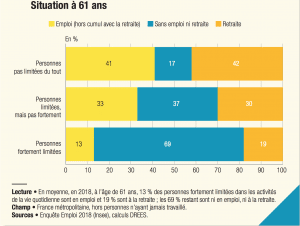 Certainly, there is an early retirement scheme for disabled workers. It allows individuals to claim their retirement rights between the ages of 55 and 59. But its conditions are so restrictive that in 2018, fewer than 3,000 people were able to benefit from it.
As a result, at 61 years old, 42% of non-disabled individuals are already retired, compared to 19% of disabled individuals.
The harsh impact of the legal age
Moreover, the study highlights the abrupt effects of the 2010 reform, which raised the minimum legal retirement age from 60 to 62. For disabled individuals aged 50 and over, the average duration of employment has not increased at all. The change in retirement age has thus resulted in an increase in the time without employment or retirement. In short, they have had to live longer without pay or pension.
Too timid a reform
All these elements call for a relaxation of the conditions for access to early retirement for disabled workers. The pension reform bill, which has been debated in a plenary session at the National Assembly since today, unfortunately does not go far enough. The text removes only one of the three conditions. The least restrictive: “This will not change much,” explains Carole Salères, employment advisor at APF France handicap. Ah, if only the deputies would read this study…
Relief at 62
At 62, the situation of disabled workers has improved. 68% are retired compared to 61% of non-disabled individuals. They benefit from another scheme: disability or recognition of incapacity to work allows for the full pension to be liquidated from the minimum age of 62, regardless of the number of validated quarters.
This system deviates from common law. Normally, it is only at the age of 67 that one can retire at full rate, even without having worked long enough. The bill maintains the retirement for incapacity at 62.