
In France, 17 million people are in a precarious mobility situation according to the 2026 Daily Mobility Barometer published by Wimoov and the Groupe SOS, which represents 31% of the adult population. This figure, up from the 15 million recorded in 2024, highlights a structural problem.
Solidarity transport attempts to address this through local, associative, or institutional initiatives that allow vulnerable groups to travel when neither personal cars nor public transport are accessible.
Mobility Precarity in France: A Phenomenon That Exceeds Rural Areas
The difficulty of moving is often associated with isolated rural areas. Recent data nuance this perspective. The Wimoov/Groupe SOS barometer shows that mobility precariousness also affects urban peripheries, where public transport exists but is often unsuitable for irregular schedules, cross journeys, or the needs of people with reduced mobility.
For elderly individuals losing autonomy, job seekers without a license, or single-parent families juggling multiple daily trips, the lack of suitable transport solutions results in foregoing medical care, social isolation, or a direct barrier to professional integration. Solidarity transport is not a comfort service: it is often the last link before exclusion.
Several associations and local authorities provide information on transport with Le Voyageur Solidaire that helps identify existing initiatives in a given area, whether it be car volunteering, social utility transport, or connection platforms.
Social Utility Transport, Solidarity Carpooling, and Demand-Responsive Transport: Concrete Initiatives
The term “solidarity transport” does not have a unique legal definition. It encompasses several categories that must be distinguished to understand who can benefit and under what conditions.
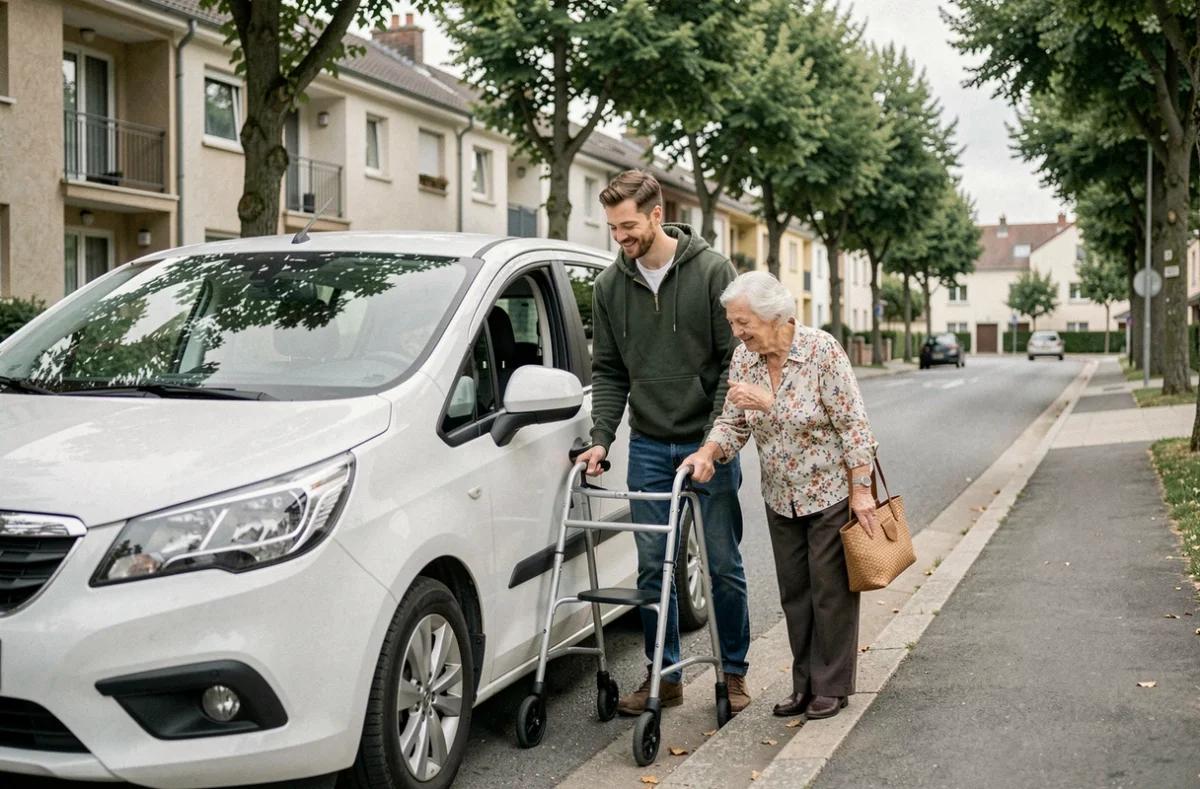
- Social utility transport (TUS) is provided by approved associations that mobilize volunteer drivers. The trips are reserved for targeted groups (elderly people, those in integration, people with disabilities) and concern defined reasons: medical appointments, administrative procedures, grocery shopping.
- Demand-responsive transport (TAD) reserved for a specific category of users operates on a model similar to classic TAD but with eligibility criteria related to age, disability, or social situation. It is often managed by community councils or mobility organizing authorities.
- Private transport services reserved (EHPAD shuttles, CCAS vehicles, initiatives supported by mutuals) complement the offering in certain areas, with geographical scopes and target groups varying widely from one community to another.
Solidarity carpooling constitutes a fourth avenue, less institutionally regulated. Digital or associative platforms connect volunteer drivers with passengers facing mobility challenges, sometimes with a symbolic financial contribution covering fuel costs.
A System Based on Volunteering
The vast majority of solidarity transport services rely on volunteer drivers, often retirees. The renewal of volunteers remains a major challenge to keep the service afloat. When a driver stops, it can sometimes leave an entire geographical area without a solution.
Reimbursement for mileage expenses varies by organization. Some associations fully reimburse expenses, others offer a flat rate, while some do not reimburse anything at all. This disparity directly influences the ability to recruit and retain volunteers.
Solidarity Mobility Platforms: The Shift of the Pact of Solidarities
Since the launch of the Pact of Solidarities by the State, the policy of solidarity mobility has taken on a national dimension. The Pact provides for scaling up the deployment of solidarity mobility platforms aimed at low-income individuals in socio-professional integration. These platforms serve as a one-stop shop: they diagnose the barriers to a person’s mobility and then direct them to the appropriate solution (social license, rental of a vehicle at a solidarity rate, social utility transport, bicycle training).
This national framework changes the game for local authorities. Solidarity transport is no longer just an isolated associative initiative: it is part of a system integrated with employment, health, and poverty reduction policies. However, feedback from the field varies regarding the actual capacity of the platforms to meet needs in the least equipped areas.

What Platforms Change for Beneficiaries
Before these platforms, a person facing mobility difficulties had to identify the relevant association or service in their area on their own, a process often opaque. The platform centralizes the offering and provides individualized support. For a job seeker who declines offers due to lack of transport, access to a mobility diagnosis can remove a concrete professional barrier.
Limits and Blind Spots of Solidarity Transport in France
The model of solidarity transport presents structural fragilities that institutional reports identify without always proposing solutions.
The dependence on volunteering, already mentioned, is compounded by a problem of geographical coverage. Two neighboring municipalities can offer radically different service levels depending on whether or not an active association is present. No enforceable right to solidarity transport exists under French law, meaning that a resident of an uncovered area has no recourse.
The environmental question is starting to enter discussions. Pooling trips or integrating electric vehicles into associative fleets are among the proposed avenues, but available data does not yet allow for measuring the concrete progress of these recommendations on the ground.
Solidarity transport remains a catch-up mechanism, not a systemic solution. It fills the gaps of an insufficient public transport network in many areas. As long as regular train or bus lines do not exist, the volunteer behind the wheel remains the last resort for millions of French people.