
The market for wellness services aimed at businesses has quickly structured itself in recent years. Behind the multiplication of offers (massages, sophrology, coaching), a regulatory framework increasingly constrains employers to document and justify their prevention actions. Wellness professionals who want to develop their business with companies must contend with this reality: offering a one-off workshop is no longer enough.
Prevention obligation and DUERP: what wellness providers need to understand
Articles L.4121-1 and following of the Labor Code impose a security obligation on the employer that covers both physical and mental health. Psychosocial risks must be included in the single document for assessing professional risks (DUERP), just like chemical or physical risks.
For companies with at least 50 employees, this assessment must lead to an annual prevention program, the PAPRIPACT. The DUERP must be kept for at least 40 years, making it a structuring document for the long term.
A wellness provider who ignores this framework positions themselves as a mere facilitator. Those who integrate it into their sales pitch and deliverables (intervention reports, monitoring indicators, written recommendations) become partners in the prevention approach. The difference lies here: human resources departments are looking for evidence of deployment, not just relaxation moments.
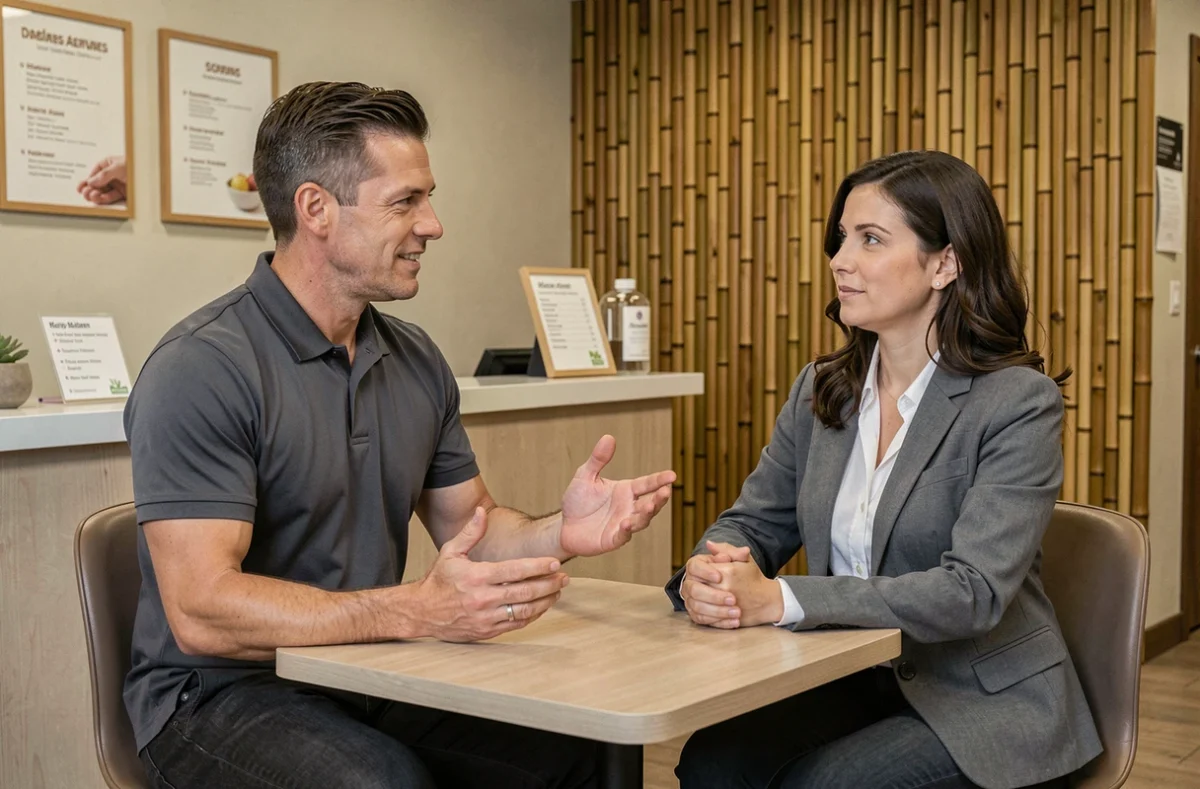
Wellness services for professionals: structuring an offer that goes beyond isolated workshops
Most competitors in this market offer catalogs of workshops: seated massage, reflexology, yoga, sophrology. The format is established, and there is demand. However, feedback from the field diverges on the actual impact of these interventions when they remain occasional.
What distinguishes a viable offer from a disposable service is the ability to be sustainable. Wellness professionals who list their services on the Pur Bien-Être website for professionals gain visibility with an already aware clientele, simplifying the prospecting phase.
A professional wellness service must include a measurable follow-up component. This can take several forms:
- Regular assessments sent to the client’s QVT (Quality of Life at Work) referent, with simple indicators (participation rates, anonymized qualitative feedback).
- Adaptation of the program based on observed results and changes in working conditions (partial remote work, team reorganization).
- Documentation that the employer can use to feed into their DUERP or social report, demonstrating that the actions are not merely cosmetic.
This positioning requires extra effort compared to a simple hourly service, but it justifies higher rates and fosters client loyalty.
Remote work and new organizations: adapting wellness services to the real context
Prevention measures must now take into account remote work, coworking, and flexible work. A uniform relaxation offer no longer meets the realities on the ground.
A practitioner who only intervenes in person at the company’s premises loses an increasing number of concerned employees. Hybrid formats (video conference sessions, asynchronous micro-workshops, remote-accessible prevention content) are becoming a selection criterion for buyers.
Specifically, a massage professional cannot digitize their service. However, they can complement their physical interventions with self-massage guides or filmed sequences for preventing musculoskeletal disorders. The challenge is to cover all employees, not just those present in the office on the day of the workshop.
Employer responsibility and provider selection: the criteria that matter
The employer’s responsibility includes implementing actions, but also adapting them to evolving circumstances and ensuring appropriate means are in place. A provider who has offered the same intervention for three years without adjustment indirectly exposes their client to legal risk.
Companies prefer providers who can provide evidence of deployment. This means that a wellness professional must be able to produce:
- A planned intervention calendar over several months, consistent with the company’s prevention program.
- Written materials (awareness sheets, post-intervention summaries) that can be integrated into internal documentation.
- Demonstrated adaptability: modifying the format after negative feedback, adding a specific module after identifying a new risk.
Mental health has become a visible regulatory priority since 2025. Providers who integrate this dimension (stress management, prevention of burnout, detection of early warning signs) position themselves in a growing segment, where purely physical workshops are stagnating.

The market for wellness solutions for professionals no longer rewards catalog diversity. It values the ability to document, adapt, and measure. A practitioner who structures their offer around these three axes meets the expectations of employers constrained by legal frameworks, while building a more stable business than a succession of isolated services.