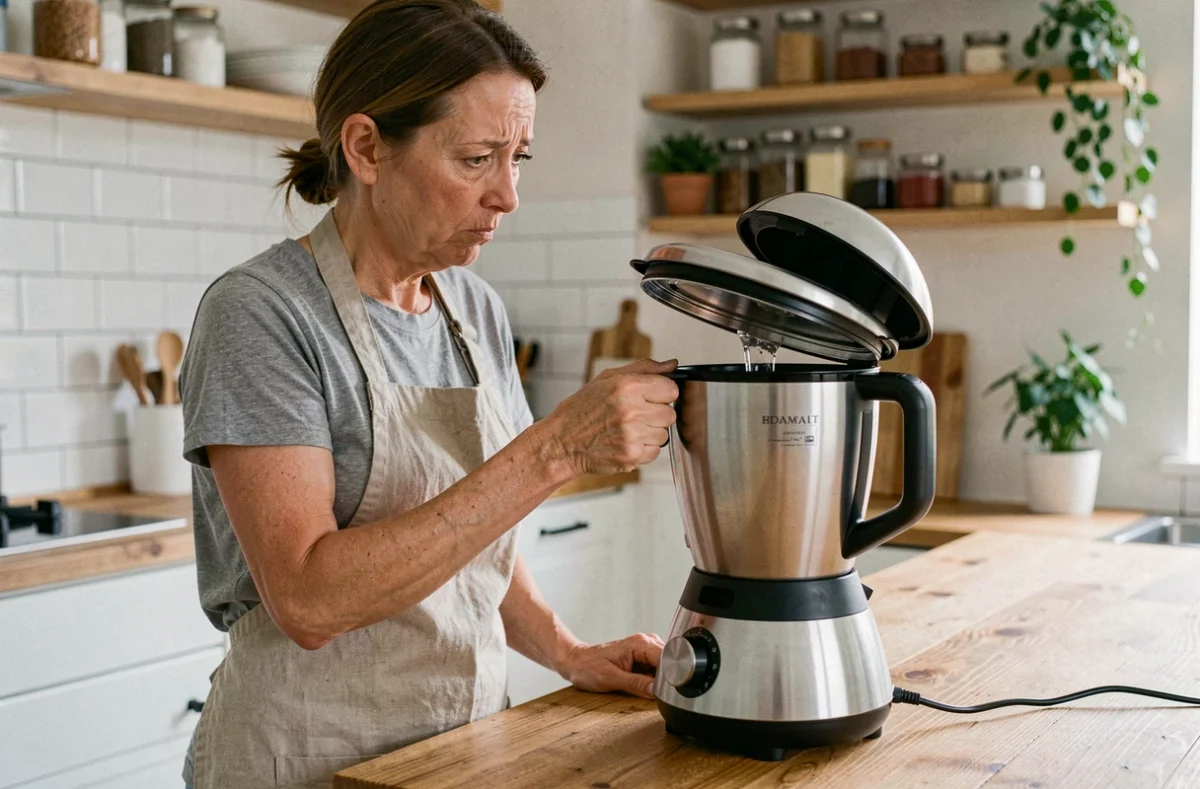
A heating blender that spins idly, leaving whole chunks in the soup or making unusual noises without blending anything: this problem is common, and the causes are rarely singular. Precisely identifying the source of the malfunction helps distinguish what can be fixed in five minutes from what requires a part replacement.
Motor-blade transmission: the invisible failure of the heating blender
Most users suspect the motor first. In the majority of cases, the motor is still functioning. The spinning noise is audible, the base vibrates normally, but the blades remain still or turn slowly.
The problem often lies between the motor and the blades. The drive socket or coupling piece provides the mechanical link between the motor shaft and the blade block. When this part is worn, cracked, or deformed, the motor runs idle without transmitting its power to the blades. An abnormal play in the blade block shaft usually confirms this diagnosis.
If you are trying to understand why my heating blender no longer blends, this coupling piece is the first element to visually inspect. It can be removed without tools on most models.
| Observed symptom | Probable cause | Concerned part |
|---|---|---|
| The motor runs but the blades do not move | Broken mechanical transmission | Drive socket / coupling |
| The blades turn slowly, without force | Partial wear of the coupling or overload | Coupling piece, shaft |
| The motor does not start at all | Safety activated or electrical failure | Cover switch, electronic board |
| Metal scraping noise | Misaligned shaft or foreign object | Blade block, central shaft |
Dull blades and blocking residues: two mechanical causes to check
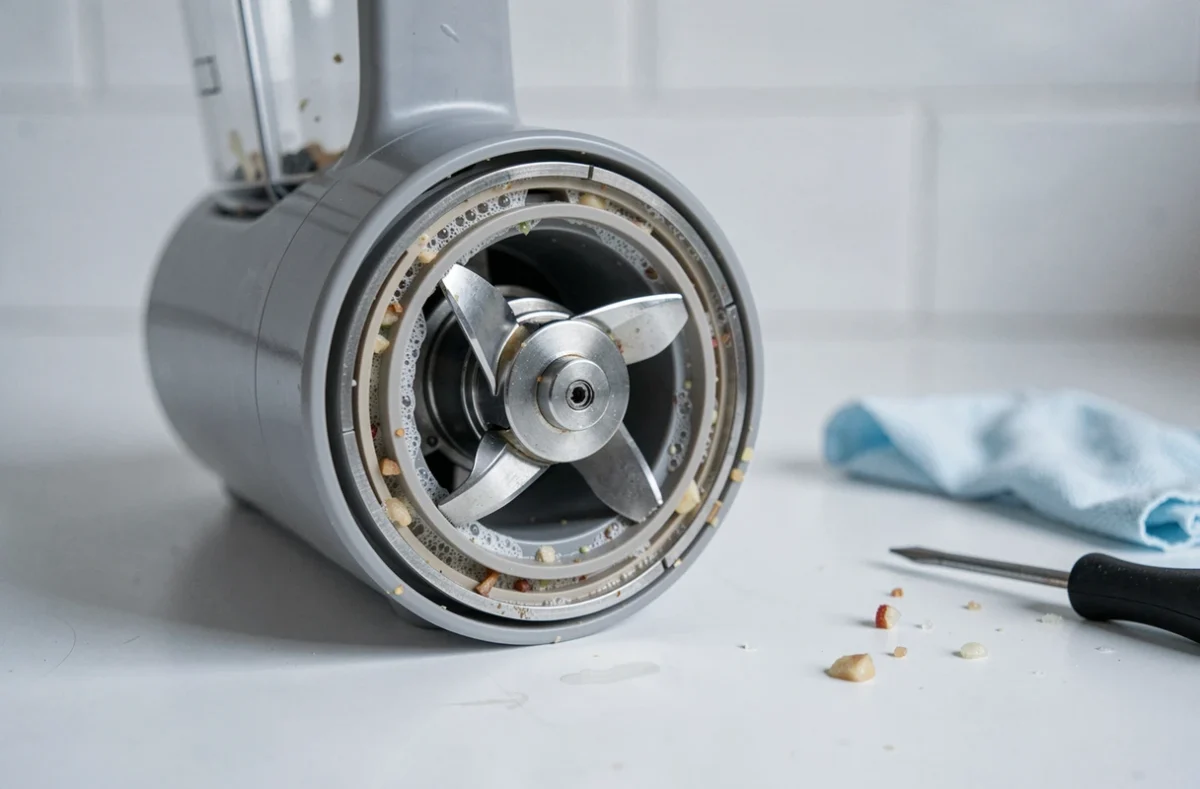
The blades of a heating blender dull over time. A dull blade no longer cuts, it pushes the food away. The result: a grainy soup, intact chunks after several minutes of operation, and a motor that strains unnecessarily.
Run a finger (with the device unplugged) along the edge of each blade. If the edge is rounded, smooth, with no grip, the blades have lost their effectiveness. On some models, the blade block can be replaced as a single piece without disassembling the device.
The clogged hub, a common trap
Delayed cleaning after use can gradually immobilize the blade block. Residues of pulp, thick puree, or greasy preparations harden around the hub and limit rotation. The device seems to operate normally, but the blades struggle to reach their nominal speed.
- Dismantle the blade block after each use and rinse the hub immediately with hot water to prevent the accumulation of dried residues.
- Visually check that the shaft turns freely by hand, without any stiffness or abnormal resistance.
- If the blockage persists, soak the blade block in soapy hot water for about twenty minutes before scrubbing with a fine brush.
Absence of vortex: when the problem comes from the preparation and not the device
A heating blender needs a vortex to blend properly. This circular motion draws food towards the blades, crushes it, and then sends it back up to the top of the bowl. Without a vortex, ingredients remain stuck to the walls or spin above the blades without ever reaching them.
A preparation that is too dry prevents the formation of the vortex, even if the motor and blades are functioning perfectly. Wilfa recommends adding liquid in this case and starting at low speed before gradually increasing.
The filling of the bowl also plays a direct role. An overfilled bowl prevents circulation, while an underfilled bowl allows food to escape the blades due to lack of pressure. The suitable range is generally between the minimum mark and two-thirds of the capacity.
Thermal shock and bowl sealing defect
Heating blenders undergo thermal stresses that traditional blenders do not. Pouring a cold liquid into a hot bowl (or vice versa) can deform or even crack the container. Wilfa explicitly advises against this practice.
A deformed bowl alters the positioning of the blade block. Even a slight deformation, invisible to the eye, is enough to create play between the bowl and the base. The blades are no longer centered, blending becomes uneven, and leaks may appear at the seal.
Warning signs to watch for
- Moisture traces under the bowl after use, indicating a seal or micro-crack.
- The bowl no longer clicks as firmly onto the motor base as before.
- Unusual vibrations during operation, indicating misalignment between the bowl and the shaft.

Electronic safety features and power board: silent failures
Most heating blenders include a safety switch related to the lid. If this switch does not detect the proper closure of the bowl, the motor refuses to start. A simple misalignment of the lid or a worn lid seal may be enough to trigger this safety feature.
On some models, the blender goes into safety mode with an error code displayed without a clear explanation in the manual. The electronic board may also be at fault: a power surge, repeated overheating, or a faulty component prevents the device from starting the blending cycle, even if the heating function remains operational.
This last scenario (functional heating, inoperative blending) points to a problem with the power board or thermal protections. Replacing the board usually requires the intervention of a home appliance repair technician, as the components are not accessible without complete disassembly.
A heating blender that no longer blends correctly often combines two factors: a simple mechanical cause (clogging, wear of the coupling) aggravated by poor usage practices (overloaded bowl, lack of liquid, thermal shock). Addressing the mechanical issue without correcting the usage only postpones the next malfunction.